
A week before the flea baths.
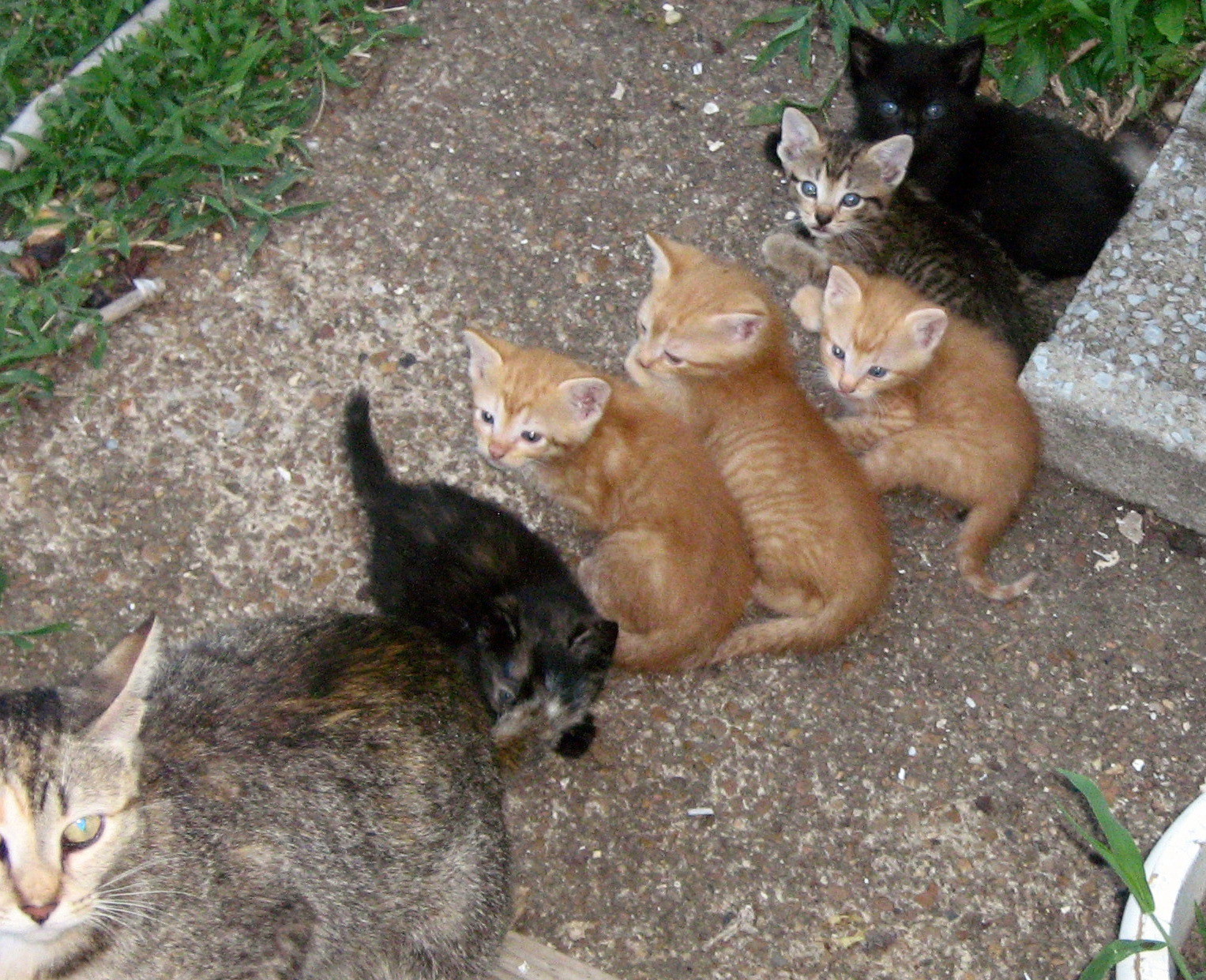
NASHVILLE. Miniaturized insects–tiny mosquitos so small they can slip through standard screen-mesh, redbugs that work their way under elastic and into armpits–own the yard. They’re so small I can’t see them, though part of that is slowed vision and middle age. The fleas, though, are fat and long, full of blood and eggs, crawling through the kittens’ fur visibly, visibly even on the solid black one (glimpses of moving mahogany carapace traveling serenely if unevenly through dark less-shiny fur). I plan the flea-baths for days. D-day is Sunday, sometime in the morning, I think (so I can catch them as they’re all gathered on the porch-step in the sun).
Saturday evening I dress for a quick grocery-store run, go outside, see kittens scurrying under my car, kneel to look, and they’re not there. I open the hood: one, two, three, four little kittens on various perches in the engine compartment. There are a surprising number of these small perches, most of them kitten-sized. One of them is accessible and I reach in and scruff the black kitten (whom I’d despaired of getting my hands on–too quick, too smart) and lift it gingerly through the hoses and pipes, then tuck it beneath my shirt and take it inside, hustling it quickly-quickly into the bathroom and the cat-carrier I had ready for the following day. Tonight’s the night. Grocery-store errands can wait.
One down. Back outside. I catch the little tabby, fierce and beautiful, wild tabby-genes efflorescing on her black-gray/russett pelt; under the shirt she goes and inside (as I carry her I feel rather than hear her spitting, tiny explosions against my skin) to be imprisoned with her sister. Next: the big ginger boy. He’s the largest of the litter and has moved obediently into the accessible perch; he allows me to lift him out (hisses once, perfunctorily) and rides quietly inside. Tabby spits again as I open the carrier door to deposit him; black kitten gazes silently from behind her sister. Back out: there are two more gingers and the tortoiseshell yet to go. One of the gingers is in the engine compartment, but in a tiny inaccessible perch. I spend fifteen minutes trying to reach him or coax him into a different area. Ultimately he finds a niche somewhere near the catalytic converter and I’m afraid to pursue him any longer (what if he squeezes himself into a spot he can’t get himself out of? Nightmare–). I stand up, sigh, turn and see that the third ginger is under the steps, crouched and watching. I walk the ten paces to him, pick him up with no trouble, and under the shirt he goes.
It will have to be these four, I decide. The tortoiseshell is nowhere to be seen and I’m still afraid to pursue the second ginger-kitten near the catalytic converter. I shut Djuna in the bedroom (she rakes the door with her nails and barks in that shrill I’ve-been-betrayed way) and Jake, Elwood, and Jason in the guestroom (Jake and Elwood’s pupils dilated almost to black, Jason hiding in beneath the dresser). I set the AC on 78, shut the bathroom door, get out the nail clippers, and open the carrier door.
They’re all near the back, clambering over each other to try to disappear. I decide to clip the black one’s claws first; she’s the canniest of the lot, and perhaps the most frightened, and I want to give her time to recover between nails and bath. She hisses as I pick her up but allows me to put her on my lap. She doesn’t claw or try to escape once there–perhaps she’s simply paralyzed with fear. I manage to clip her tiny claws, the diameter of dental floss. Back she goes and out comes the small ginger-kitten. His nostrils are crusted with brown goo and he stinks of cat pee. As I hold him he cries, hisses, spits, paddles his paws to try to get purchase and run. I can see the fleas milling through his cream-and-yellow coat. I lean over him as I sit, making a small dark cave. He quiets down, and I hear my breathing and feel his, small flanks fluttering up and down five times for every one breath I take. Finally I lift myself up and uncurl a paw and manage to clip. I catch his delicate toe-fur once and he squalls, and I am so appalled I lean over him again, compulsively repeating I’m-sorry-I’m-sorry-I’m-sorry. I can barely bring myself to finish clipping him but I do it.
I decide to try to remove some of the fleas before the bath. They’re so visible, so evident, I just want to grab them with my fingers and crush them, but they burrow down and hold with amazing tenacity to the soft fur, and I can’t pull them off without pulling fur–and hurting the kitten again. So I use the comb (after filling a little cup with hot water and detergent one-handed, kitten back under my shirt). I collect eight or ten fleas. Then I put him back in the carrier and do the same with the larger ginger-kitten (completely infested) and the tabby (very few fleas. Is she so small that fleas ignore her as a meager meal? Is the large ginger fatter, juicier? I try to look at the tabby’s gums; she hisses and will not allow it).
Then I fill the bathroom sink with a-bit-warmer-than-tepid water and immerse the little tabby (all but the head; she goes suddenly quiet as her body enters the water–maybe she thinks the game is up, that I’m about to drown her). When she’s wet I lift her out and apply dish soap, keeping her above the water just long enough to massage the soap through her fur to the skin, and dip her back into the sink. Dirt floats off in plumes. And fleas. They were hiding somehow. I massage her fur under the water (she is straining her legs to try to stand up now) as well as I can, trying to flush the fleas out, to prevent them from scrambling over her face and leaping to safety. When I feel the water-temperature drop a little I lift the kitten out, pull the drain, turn on the water (tepid plus a bit), close the drain and put her under the faucet until the clean water’s deep enough to submerge most of her. More fleas float off. I comb her hair with my fingers, massage, search for fugitives. Then she meows: she’s had enough.
I drain the sink and lift her up and bury her in a towel and rub, rub, rub (gently but briskly enough so that she can’t get claw-purchase and jump down). When that towel is damp I use a new one. Finally it seems to me she’s almost dry but I also feel her shudder minutely. I wrap her completely in the towel; she mustn’t become hypothermic. She’s so small. The smallest of the lot. I sit down and lean over again, trying to preserve body heat. She shudders a little more, then it seems to subside. I sit up, wrap her in a third towel, rub her briskly, then wrap her in the towl and set the whole bundle down in the carrier. She stays there. I see the towel vibrate with her shudders once or twice, and then it becomes quiet. I lift a corner to peek. She’s curled up and fast asleep, little flanks rising and falling.
The procedure for the remaining three is identical. They all go quiet when dipped into the warm water and all throw off dozens of fleas after being soaped. How have they survived? The fleas must have been consuming half their blood. I towel them briskly, briskly. The one change is that I feed them after the washing and drying. A small bowl of food–dry food and canned chicken–has been sitting in the carrier, but no one has approached it. When I offer it to them from my hand, though, they eat–ravenously. I pick up Tabby’s towel and offer it to her as well; she wakens, then wolfs the food down, shaking her head in that feline I-have-killed-it gesture after the first bite.
I transfer the clean, dry, sleepy kittens (all conked out immediately after being bathed and then eating) into the “clean” carrier and open the bathroom door. Surprisingly, it’s still light outside; the whole process has taken less than two hours. The mother meows stridently, vexed, as I remove the kittens and put them down next to her (each scampers away to hide under the steps). I am relieved yet somehow more worried than ever. I go back inside, release the frantic dog from the bedroom (she barks furiously at the “clean container” despite the fact that the kittens were in it less than five minutes) and the still wide-eyed grown-up cats from the guestroom.
I strip off my clothes and gather them up, along with the soaked towels (there are live fleas on several–how do they survive soap and drowning?) and put the whole mass in the washing machine, shutting the lid quickly and choosing “hot.” I clean out the “dirty” carrier, remove it and the cardboard I’d laid down in the tub to keep the kittens from getting chilled by the porcelain, and take a hot shower. Then I eat heated-up leftovers in front of the TV, one foot propped on the dog next to me on the couch.

 Morning-Land